
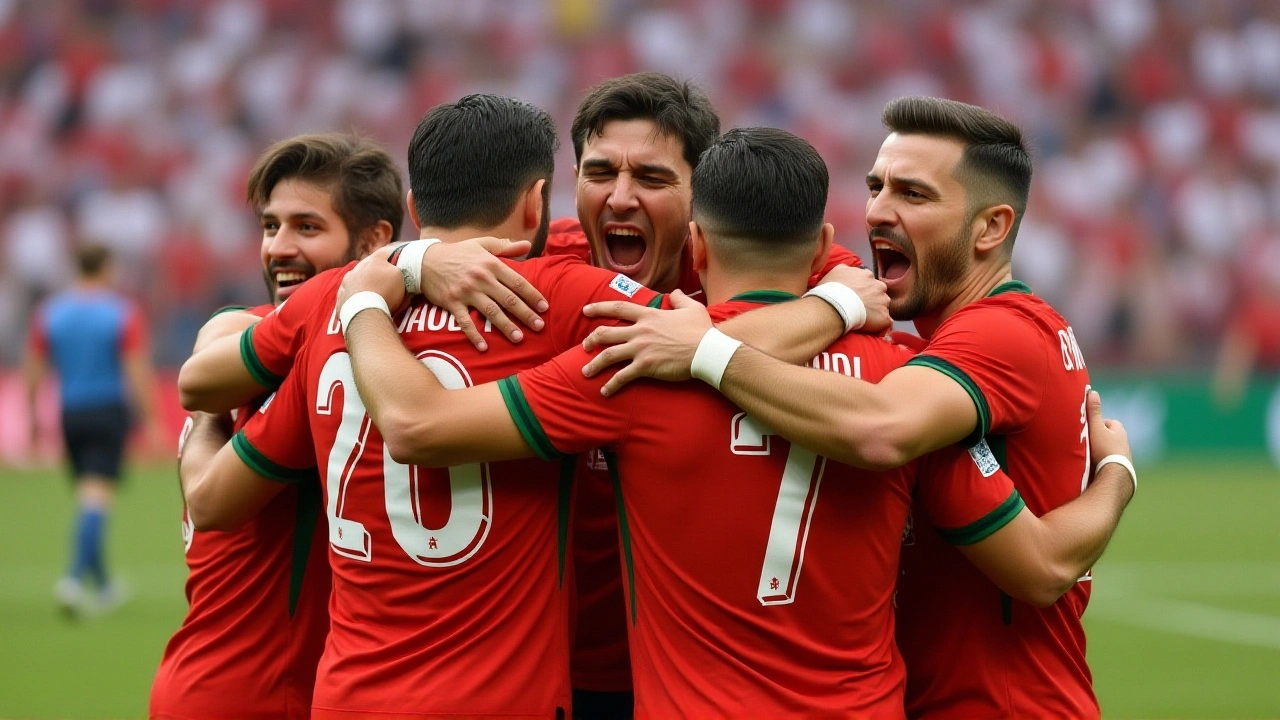
When Portugal national team travels to face Republic of Ireland national team on October 11, 2025, all eyes turn to the marquee clash that could reshape Group E in the UEFA European qualifiers. The fixture kicks off at 11:45 UTC, with Dutch referee Richard Martens blowing the whistle. Leading Portugal’s attack is veteran forward Cristiano Ronaldo, who is eyeing another goal haul to cement his legacy as the campaign heats up.
Why this match matters for the qualification race
The European pathway to the 2026 FIFA World Cup is unforgiving. Only the group winners earn a direct ticket to the finals in North America, while second‑place teams must survive a grueling playoff. Portugal sit atop Group E with six points after a 2‑0 win over Kazakhstan, but Ireland, rattled by a 2‑1 loss to Armenia, cling to five points and need a win to keep their hopes alive. A slip‑up could relegate the Irish side to the playoff gauntlet, a route that historically favors the deeper‑pocketed nations.
Form guide: Portugal’s firepower vs Ireland’s resilience
Portugal have been prolific in front of goal this qualifying round, netting 12 in three matches. Aside from Ronaldo, the midfield engine Bernardo Silva has contributed five assists, while young talisman João Félix adds a fresh burst of speed on the flanks. Their defensive line, marshaled by Rúben Diaz, has kept clean sheets in two of the three games.
Ireland, on the other hand, have struggled to score but have shown grit. Striker Jack McGlynn is their most recent goal scorer, and midfielder Conor Washington has been pulling the strings. Their back four, led by veteran Seán Mayo, has limited opponents to an average of 1.3 shots per game – respectable but not impenetrable.
Tactical showdown and the referee’s role
\nPortugal’s manager Roberto Martins favors a fluid 4‑3‑3 that presses high and exploits space behind the Irish defence. Expect full‑backs João Cancelo and Nuno Mendes to surge forward, creating overloads on the left.
Irish boss Stephen Clarke will likely set up a compact 4‑2‑3‑1, looking to absorb pressure and strike on the counter‑attack. The midfield pivot of James McCarthy and Seán Finn will be crucial in breaking up Portuguese rhythm.
Referee Richard Martens brings experience from the Eredivisie and European club competitions. Known for a balanced approach, he rarely issues early yellow cards but will crack down on reckless challenges – a factor that could influence Portugal’s high‑pressing style.
Broader qualification landscape
- Group E currently: Portugal 6 pts, Ireland 5 pts, Kazakhstan 3 pts, Armenia 2 pts, Faroe Islands 0 pts.
- UEFA has 13 direct spots; the remaining spots funnel through a playoff involving the best runners‑up and Nations League performers.
- President Aleksander Čeferin warned that “every match now feels like a final” as the calendar squeezes fixtures into the October window.
Meanwhile, FIFA President Gianni Infantino has emphasized the importance of the qualifiers for the sport’s global growth, especially with the 2026 tournament set to be the first jointly hosted by three nations – the United States, Canada and Mexico.

What fans can expect and what comes next
The match will be streamed live on UEFA’s digital platform, with in‑stadium attendance expected at the Estádio da Luz in Lisbon – a venue that can hold nearly 65,000 fans. For Irish supporters, a win would not only boost morale but also force Portugal into a must‑win scenario in their next fixture against the Faroe Islands.
Looking ahead, the final round of group matches is slated for November 2025, followed by the playoff draw in March 2026. Should Ireland slip into the playoffs, they could face any of the other second‑placed teams, a scenario that would reignite memories of the 2018 drama when they lost to Denmark on penalties.
Frequently Asked Questions
How does this match affect Portugal’s chances of qualifying?
A win would solidify Portugal’s position at the top of Group E, giving them a cushion before the final game. Even a draw keeps them ahead of Ireland, but a loss would hand the Irish side the chance to leapfrog and force Portugal into a high‑stakes showdown in November.
What are Ireland’s realistic objectives for this fixture?
Ireland must win to remain in contention for a direct spot. A victory also pushes Portugal into a pressure‑filled final match, giving the Irish side a psychological edge while keeping their playoff hopes alive if the group ends level on points.
Will Cristiano Ronaldo likely start, and how important is his goal tally?
Ronaldo is expected to start and take set‑pieces. At 40, he remains Portugal’s primary scoring outlet, and another goal would keep him on track to become the all‑time World Cup qualifying scorer, a milestone that boosts both his legacy and the team’s confidence.
How might referee Richard Martens influence the tempo of the game?
Martens tends to allow physical play early but clamps down on repeat offenses. If Portugal’s high press triggers frequent fouls, his timing on yellow cards could disrupt their rhythm, potentially favoring the more disciplined Irish backline.
What’s the next key match in the European qualifiers after this game?
The next round of fixtures falls on November 14, 2025, when Portugal host the Faroe Islands and Ireland travel to face Armenia. Those results will decide whether the group winner is locked in or if a playoff spot remains up for grabs.
Jared Mulconry
October 11, 2025 AT 21:57Got to say, it's going to be a classic showdown. Portugal have the firepower, but Ireland's grit could make things interesting. If both sides play to their strengths, we might see a tight game that ends up on a single goal margin. Either way, it'll be a solid test for the group standings.
Brandon Rosso
October 20, 2025 AT 05:57Esteemed readers, the upcoming encounter encapsulates the essence of competitive football. Portugal’s prolific attack, spearheaded by the venerable Cristiano Ronaldo, stands poised to dominate, whilst the Irish contingent must exhibit unwavering resolve. A victory for either side will undeniably consolidate their position within Group E, and I eagerly anticipate a display of tactical brilliance.
Tracee Dunblazier
October 28, 2025 AT 12:57While the article provides a comprehensive overview, it glosses over the defensive frailties that Portugal has exhibited in recent fixtures. Moreover, the Irish side’s scarcity of goals suggests a systemic issue in the final third, not merely a matter of luck. A more critical assessment would have highlighted these vulnerabilities.
Edward Garza
November 5, 2025 AT 20:57What a mess.
Allen Rodi
November 14, 2025 AT 04:57Just to add a bit of context, Portugal’s midfield rotation this season has been quite fluid, which helps them maintain intensity throughout the match. The Irish back four, especially Seán Mayo, has been disciplined in limiting shot attempts, so expect a low‑frequency shooting game. Also, keep an eye on João Cancelo’s overlapping runs; they could stretch the Irish defense. If the referee keeps his usual restraint, the physical battles should stay fairly clean.
Jody Webster
November 22, 2025 AT 12:57Whoa!!! Did you see the stats? Portugal have netted 12 goals in three games??? That's insane,, but Ireland's defence has been surprisingly resilient… Yet, the odds… they’re still in a tight race-so every moment counts!!!
Steve Goodger
November 30, 2025 AT 20:57When considering the broader implications of this qualifier, it is essential to appreciate the intricate tapestry of tactical nuances that both managers bring to the pitch, and the ways in which these philosophies intersect with the psychological pressures inherent in a high‑stakes environment. Roberto Martins’ preference for a fluid 4‑3‑3 formation is not merely a cosmetic choice; it reflects a commitment to positional interchange that allows players such as João Félix and João Cancelo to exploit the half‑spaces, thereby destabilising even the most organized defensive structures. Conversely, Stephen Clarke’s compact 4‑2‑3‑1 setup is designed to absorb pressure, relying on disciplined midfield pivots like James McCarthy and Sean Finn to act as a shield while providing quick outlet passes to the forward line for counter‑attacking opportunities. The presence of Cristiano Ronaldo, now in the twilight of his career yet still possessing an indomitable hunger for goals, adds a layer of strategic depth that cannot be ignored, as his movement off the ball often draws multiple defenders, creating space for his teammates. Moreover, the role of the referee, Richard Martens, should not be underestimated; his balanced approach to early caution, coupled with a willingness to clamp down on repeat offenses, may influence the tempo and the willingness of Portuguese attackers to press high. In terms of group dynamics, a win for Portugal would not only cement their lead but also afford them strategic breathing room, allowing them to rotate key personnel without jeopardising qualification. On the other hand, an Irish victory would shift the narrative dramatically, forcing Portugal into a must‑win scenario in their final group game against the Faroe Islands. It is also worth noting the psychological aspect: the weight of history sits heavily on both sides, with Portugal seeking to reaffirm their status as a European powerhouse, while Ireland aim to overcome the lingering disappointment of the 2018 penalty shootout loss to Denmark. The fans in Lisbon, with the stadium nearing capacity, will undoubtedly create an electric atmosphere that could either inspire the home side or add pressure. From a statistical viewpoint, the fact that Portugal have already scored twelve goals in three matches suggests a high conversion rate, yet football is a game of moments, and an early goal could tilt momentum irrevocably. Ireland’s resilience, demonstrated by limiting opponents to an average of 1.3 shots per game, indicates a disciplined defensive effort, but they must unlock the final third to remain competitive. Finally, the broader qualification landscape-where only group winners gain direct entry-means every point is priceless, and the stakes are amplified by the looming playoff scenarios for second‑place teams. All these variables intertwine to create a match that transcends mere sport, offering a microcosm of strategy, psychology, and national pride. In conclusion, whether you are a neutral observer or a die‑hard supporter, the upcoming clash promises to be a compelling chapter in the story of Group E.
johnson ndiritu
December 9, 2025 AT 04:57Honestly, the hype is overblown 🙄. Ronaldo’s age is showing, and the Irish lads will love any mistake he makes 😂. If the ref whistles for a foul on the Portuguese, expect a flood of drama on social media 🚩.
sheri macbeth
December 17, 2025 AT 12:57Oh sure, because the universe definitely wants Portugal to win so the sponsors can sell more jerseys. Meanwhile, the Irish team is probably plotting a secret strategy involving lucky charms and ancient Celtic rituals. Either way, we’ll all be glued to the screen, right?
Lane Herron
December 25, 2025 AT 20:57From a tactical schema standpoint, the high‑press alignment deployed by Martins aligns with a vertical pass‑and‑move framework, which, when juxtaposed against Clarke’s low‑block paradigm, creates a dichotomous entropy within the midfield battleground. The resultant phase‑transition could precipitate a rapid tempo shift, forcing the Irish defensive lattice into a sub‑optimal state. In essence, the match is a case study in positional entropy versus structural rigidity.
Henry Cohen
January 3, 2026 AT 04:57Everyone's actin like this match is the end of the world, but really it's just another game. If Portugal slips up, it's not because they're old, it's because they've been overhyped. Ireland could actually take advantage of that complacency.
Mark Langdon
January 11, 2026 AT 12:57Totally on point with the midfield rotation insight, Mark here. Those rotation policies keep the guys fresh, especially with the travel schedule. Also, keep an eye on the weather; a drizzle could make those overlapping runs a bit slippery.
Ciara Russell-Baker
January 19, 2026 AT 20:57yeah i think u r right bout the weather, cah it's gonn be wet an' sloooow. Maybe the irish will have an edge wif the ball staying low.
Aaron Samarita
January 28, 2026 AT 04:57Wow, that's a lot of fancy talk for a game that could end 1‑0. Honestly, all that jargon doesn't change the fact that sometimes a single miscued pass decides everything.
Daisy Pimentel
February 5, 2026 AT 12:57We must remember that sportsmanship transcends technical analysis; the spirit of the game demands respect for both teams, regardless of tactical verbosity. It's essential to celebrate the human effort behind each pass and tackle.
Ellen Ross
February 13, 2026 AT 20:57Indeed, Daisy, but it's also crucial to acknowledge that the underlying philosophy guiding each coach's decisions reflects broader cultural narratives, which can be both enlightening and, at times, pretentiously convoluted.
Fabian Rademacher
February 22, 2026 AT 04:57Honestly, if you think they're just playing for fun, you're missing the whole point. There's always a hidden agenda, whether it's about political leverage or media contracts.
Terrell Mack
March 2, 2026 AT 12:57Look, regardless of the conspiracies, it’s going to be a solid match. Expect the Irish to stay compact and Portugal to push high-just enjoy the game.